
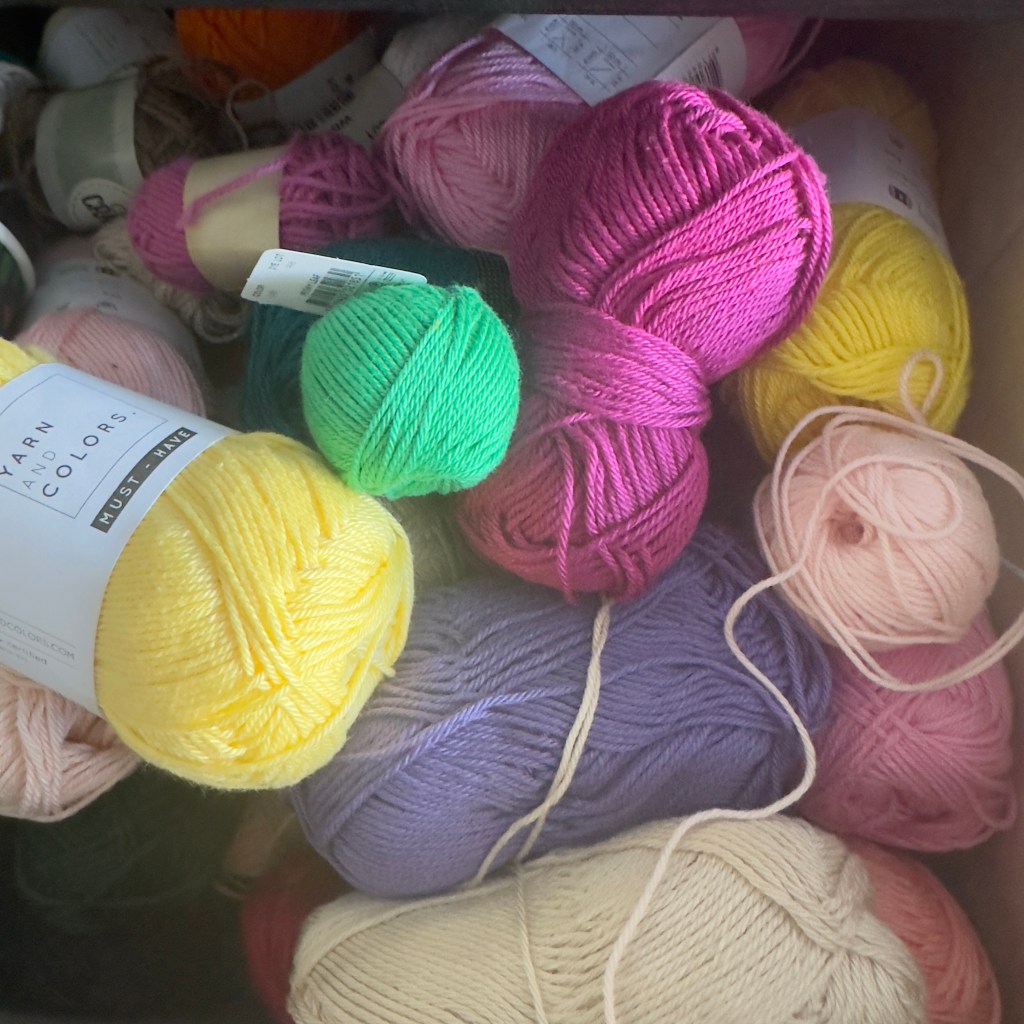
This question came from one of my newest members of the Hooked on Crochet Club. She was after suggestions for how to figure out what yarn she had in her stash was and how she could store it better in the future. And I get it. We finish a project, have left over yarn and usually by that stage we’ve lost the label and just dump it into a basket of other left over yarns. The end result is a basket filled with yarn that we have no idea what fibre or ply it is, so we just let it sit there.
Now some of what I am going to suggest is going to take some discipline and action BEFORE you start using the yarn, but I promise it is short term pain for long term gain.
If you have yarn that have already laying around unused then here is a suggestion for how to figure out what fibre and ply it is. Find other yarn in your stash and compare it. You can lay the threads side by side and compare for thickness and for how it looks. In my experience cotton and acrylics look very different, so you can usually tell them apart. Acrylic and wool however can look quite similar, you can try to destroy them as they will have different burning properties, but I am not going to suggest that! Just take your best guess and then try in future to take notes before you start.
Below are my recommendations for how to keep track of your left over yarn so that you can store it with more confidence.
The first, is the simplest but only works if you have a stash of yarn on hand for dipping into. And that is to just put it back with the same yarn. You will know then that it is with it’s ‘family’ so you can just read a label from a new ball to figure out what fibre it is and what hook to use.
The next is what I do when I am designing. I might not always have yarn left over and I always write the notes for my designs into a note on my phone that is stored into a folder. It makes it easier to locate the details that I need for the yarn once I get to the part of writing up my patterns. And it can make for an easy reference tool with the left over yarn. You can also take a before and after photo too so that it is easier to recognise the left over bits.

Another option is to make pegs of the yarn. This is helpful if you want to buy more of the yarn later too. Just make sure you record the brand, the ply and the colour plus colour reference number so that it is easy to repurchase. The wooden pegs are quite cheap to buy and can be stored in containers.

And this last suggestion is similar to the first suggestion, but is for those that prefer to have a “hard copy”. You can create a folder of the yarn. The one displayed is a sample card that I have received from the supplier, but you can easily create your own with some paper and sticky tape or glue. You could easily start an exercise book or small folder of yarns that you have used. And both the first and this last one also allow for you to write any other notes that might go with it, like what project you used it on and how much you liked or didn’t like it. You could even note down how much you have left over.

So which one do you think will work best for you? Maybe you have a another suggestion that I haven’t included here – I would love to hear it!
Maybe you have another question related to yarn that you need answered? I’m always looking for more blog post ideas so I would love to hear them!
Seona x
 Honouring M.E. Crochet Blog
The method I would prefer would be the binder suggestion, or the note folder …to be tested. I really enjoyed this blog and thank you for your patience with me.
LikeLike
Hi Seona, I no longer have a yarn stash. I crochet squares, sewed them together and donated the small blankets to the RSPCA for cats to snuggle and keep warm.
LikeLike
That’s so lovely of you!
LikeLike
Hi senna, I like the pegs options.
I wonder if you have any suggestions for keeping track of the work that has been crochet
LikeLike
I’m glad you like the peg option 😊
To keep track of projects I would use the notes app on my phone. It’s super helpful as you can create folders and can add pictures and notes to the note. A note book or folder can also work if you don’t need photos.
LikeLiked by 1 person