One of the most common problems that crocheters face is that they can’t read a crochet pattern. And this is a problem that I love to solve for you! And I want you to know upfront that there is no overnight solution to learning how to read a crochet pattern. But I can give you the steps to take and the guidance to lead you into the right direction.
Before I start to explain, I need you to first understand that the problem is most likely not you. There are many factors that lead to someone not being able to read a crochet pattern, and the most common reason is linked to how you were taught to crochet. I’m not saying that you were taught wrong, but I will say that the most common reason for not being able to read a pattern is that you weren’t provided with all of the information that you needed.
So let me now help you resolve that!

To help you determine what you need to focus on, let me help you first uncover WHY you struggle. There are 4 possible reasons. The first is that you don’t remember the names of the stitches and/or you don’t recall how to make them. This is especially common when you’re just starting out. The second is that you don’t know the rules behind the construction of what you’re making. Most crochet projects are worked in rows or in the round and each of these come with rules. If you don’t know what the rules are, you’re going to find it more difficult to decipher what a pattern is asking you to do. The third reason is that the pattern has been written with assumed knowledge. But you’re not going to know that if you don’t know what you don’t know! And the final reason is that the pattern might be using terminlogy that you’re not familiar with or that you didn’t know existed! If it’s not explained in the pattern then you’re just going to be left feeling lost and confused.
The last two can really only be addressed by exposing yourself to more patterns and more crochet. The more that you try out the more that you will know. The first two are much easier and will be what I will cover here.
One of the biggest keys to reading patterns is to understand the stitches. First you’ll need to know if the pattern is written in US or UK terms. This can be tricky because both use the same stitch names, but they use them for different stitches. They also have symbols and abbreviations. Below you’ll find a quick reference guide to the basic stitches. I’ve put it together so that you can quickly compare the stitches with everything that you need to learn how to read them and make them. There are many more symbols than this, but it will at least get you started. If you want more, then my pocket guide to crochet stitches is an important purchase for you to make!
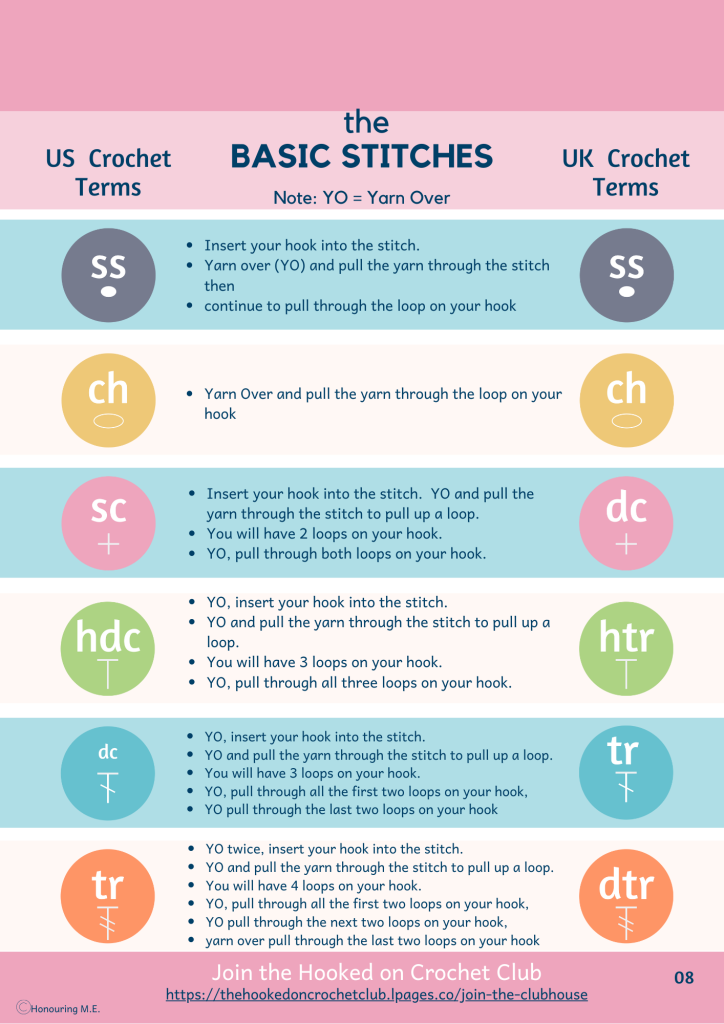
The next step is to learn the rules behind rows and rounds. Rows is when we work backwards and forwards making the project longer. Rounds is when we start from the middle and work outwards to make it bigger. Some simple things to remember is that when we’re working in rows we need to keep the same stitch count in each row. The only exception is if we’re shaping a garment and need to make it smaller or bigger. When we’re working in the round we usually want to keep our work flat. To do that we need to add stitches evenly in every round. As a general rule you will add the same number of stitches each round and space them out evenly. If you’re making a square in the round, then the increases will happen in the corners.
Something else to remember is that everyone writes their patterns differently. And a lot of the time, how they’re written is what is confusing. This is why I rewrite most patterns when I am using someone elses pattern. The use of astericks’ and brackets (**) is a common method for showing repeats in patterns. And it is one of the most confusing things to need to decipher! This is why I almost never use them. When I write a pattern I prefer to use formatting with Bold and Italics to show which parts to repeat. And I use bullet points so that each step or block of stitches is easier to decipher. So don’t be afraid to re-write steps to make it easier for you to follow.
The rest is really going to come down to practice. If you find a designer who writes patterns in a manner that makes sense to you, then stick with them! Practising to read a pattern that you already know how to make is a great way to learn. If you can find a pattern that comes with pictures and/or a video then this will help you too because you’ll have different sources to help you decipher what you’re reading.
I have some additional resources to help you learn to read crochet patterns.
The first is my free guide that covers what I have included here and gives you a bit more guidance. You can download a copy here. And don’t forget my Pocket Guide to Crochet Stitches that I mentioned earlier too.
My Square a Day Challenge has taught hundreds of women how to read patterns. It has written patterns, full video tutorials and picture guides to help you practice. For every square I also explain the chart in the video so that you learn how to read and follow them.
The most support you can get is through my Hooked on Crochet Club. Everything in the Hooked on Crochet Club is designed to help you improve on your crochet skills, including how to read patterns.
The rest is really up to you. Practice. Go easy on yourself. And if you can, reach out to the designer and ask for help. We’re human and make mistakes, so sometimes the confusion could be from a typo that we’re not aware of. And if a designer get’s lots of the same questions then (hopefully) it can help to guide them to improve on their patterns too. I know that I’ve changed how my own are written now than when I first started, so my more recent patterns are even easier to follow than my older ones.
Seona x
 Honouring M.E. Crochet Blog